
Recommitting to America's experiment
Words from Thomas Paine to the Cherokee Nation Chief inspire dedication to ideals for freedom, equality and justice for all.


.jpg)
Each Fourth of July, I find myself immersed in documentaries about America’s founding, with a recommendation this year of “The American Experiment” on Netflix. Cherokee Nation Principal Chief Chuck Hoskin Jr. is among those interviewed, providing an interesting and needed Indigenous perspective.
Many people, as reflected in several news stories, aren’t feeling as patriotic this year. It certainly pales in comparison to the 1976 patriotic bonanza of the bicentennial. But, there is worth in thinking about the ideals that created this nation.
It’s always a wonder how a group of people altered history by recognizing rights as inherent to life, rather than rights being given by a ruling class. The declaration for independence was the easy part. It was the decade-long war that followed and all the American moments that continue to try our souls making this the great experiment.
Benjamin Franklin famously quipped that the United States was a “republic, if you can keep it,” to a question posed to him while leaving the 1787 Constitutional Convention in Philadelphia. That one-liner remains our challenge.
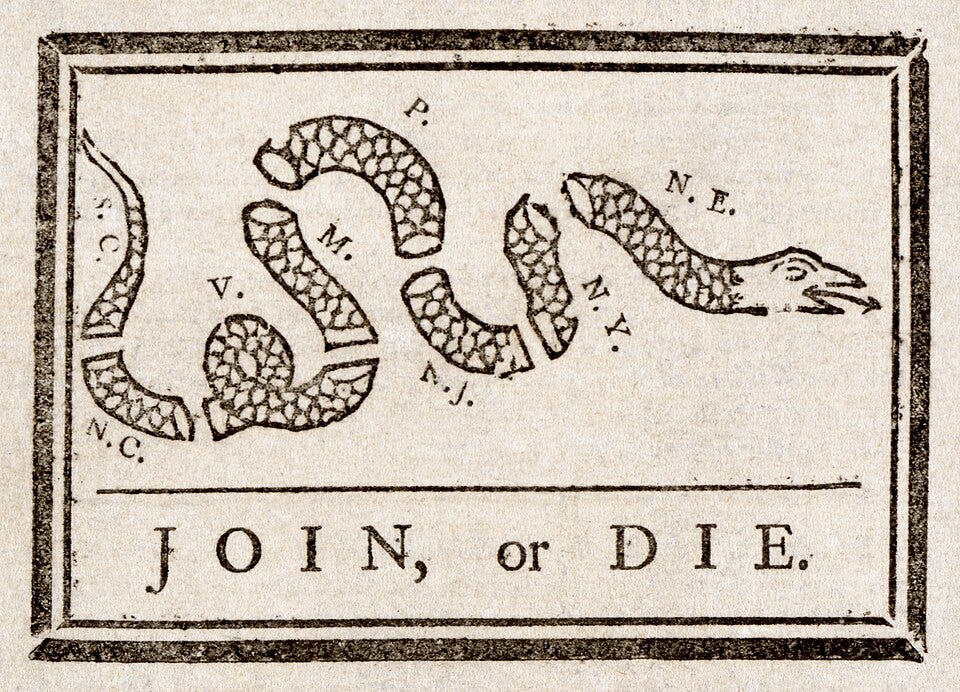
Journalism was very much a part of the nation’s break from British colonization. Franklin was a printer of the Philadelphia Gazette who published the editorial cartoon “Join or Die” that was re-published through the colonies. The 1754 cartoon has a few interpretation, but one easily sees how it means a divided country is powerless. Together, the parts can become a formidable and even dangerous beast.
Convincing colonists to fight against the greatest power on Earth was a tough go. Then came the January 1776 editorial pamphlet “Common Sense” from Thomas Paine. He entered the writing profession after other failed attempts at work. With a pen, he was a master at laying out an argument in plain language.
It sold about 500,000 copies in a few months and was read out loud in public spaces. It’s credited for changing the minds of many on the fence, including George Washington.
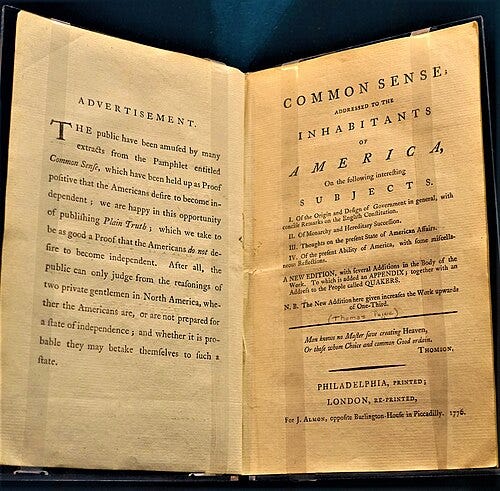
The ideas weren’t new as the revolution was underway. What Paine did was take complex political theories and render them into plain speech. He railed against a British monarchy and for self-governance in words an average person could grasp.
While much of it explained the emotion and machinations of the day, many passages remain relevant, such as this closing paragraph:
“Wherefore, instead of gazing at each other with suspicious or doubtful curiosity, let each of us hold out to his neighbor the hearty hand of friendship, and unite in drawing a line, which, like an act of oblivion, shall bury in forgetfulness every former dissention. Let the names of Whig and Tory be extinct; and let none other be heard among us, than those of a good citizen; an open and resolute friend; and a virtuous supporter of the RIGHTS of MANKIND, and of the FREE AND INDEPENDANT STATES OF AMERICA.”
How many Americans today hold others with suspicion and doubtful curiosity? How many times do we let the names of Democratic and Republican get in the way of being an open and resolute friend? Are we capable anymore of extending a hand of friendship and forgetting former dissentions?
Our republic was born out of the violence of a revolution. It was also born out of the clear-headed political philosophies and debate at the Constitutional Convention.
So many countries that win independence only turn into an autocracy. That was the worry of the delegates—too much power to the government can turn a cult of personality into a tyranny. But, too weak of a government exposes citizens to anarchy.
That push-and-pull between concerns led to several compromises, including the abdominable treatment of racial minorities and women. Slavery was left intact; Indigenous people weren’t citizens until 1924; and women couldn’t vote until 1920. That back-and-forth exists today as we work to keep our republic.
I recommend the Netflix series for its plain lanuage (in the spirit of Thomas Paine) in explaining American’s start. It doesn’t avoid the ugly parts, either.
Chief Hoskin, featured in the series, has not only proven to be a strong tribal leader but also one of Oklahoma’s great statesmen. He released a powerfully written statement for America’s semiquincentennial.
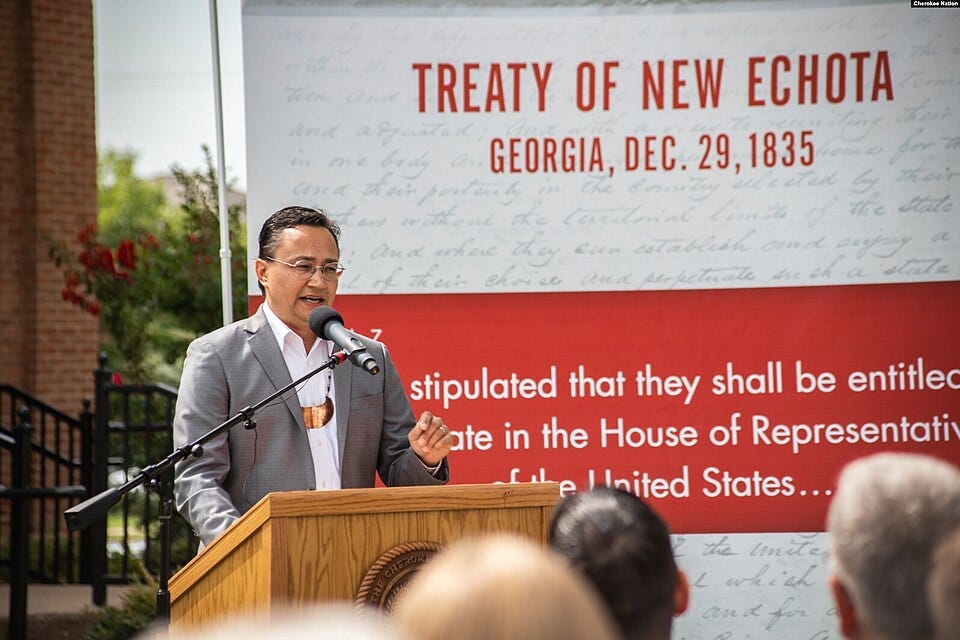

Hoskin’s statement deserves to be read in its entirety. But, here is a section worth pondering this holiday:
“Democracies have the potential to be as good as the people who participate in them. This means an America built on the backs of slaves could choose to liberate itself from slavery. This means a country which denied women and Black people the right to vote could guarantee that right.
“This means a country which chose capitalism and free markets could also choose protections for workers, consumers and the environment. This means a country of diverse views and spiritual beliefs could choose to protect, rather than suppress, freedom of speech, freedom of assembly and freedom of worship.
“This means a country founded on oppressing Native peoples can achieve a more enlightened relationship with tribal nations, respecting tribal sovereignty and keeping sacred treaty promises.
“So, as we join together to acknowledge America’s 250th birthday, let’s find reason to celebrate — but let’s be honest about even the darkest chapters of our shared history. Above all, let’s recommit ourselves to beginning the next 250 years of America’s story on a trajectory for greater equality, freedom and justice for all.”
I watched all day yesterday! This wonderful "history" lesson was given by many voices, including Chief Hoskin. Imagine my surprise to see Ted Cruz as well as Hillary Clinton as voices about this history! We have a great history, even with the sad and bad parts, and we need to "bless" that history with truth! Enough with trying to whitewash and rewrite! It's an attempt to establish we and them, and we know it to be divisive. I'm ready for opening a new door to the kind of collaboration that this country was found upon. Without that, and the resulting compromises we make along the way, we can't make progress. When Native Americans treaties get the kind of respect we give sovereign nations abroad, then we will have begun. When we allow a kind of immigration policy that makes sense, coming from Congress, then we will have begun. And when we acknowledge everyone has the right to worship in their way, we will have begun. This Netflix series pointed out our flaws, and I learned a great deal from watching! We all need to watch this five part series about the real history we've all but forgotten!
As always, Jim and I agree, well researched and well written, Ginnie. Your commentary is an important voice in the evolving world of journalism today. So glad you have found a platform on Substack and also at Tulsa Flyer.