Women rewriting rules
Conversation about how to be vulnerable, find a voice and build community

In 2019, the Oklahoma Legislative Women’s Caucus formed as a record number of women lawmakers entered office, many as freshmen. It started in the House that year as 23 of the 101 members were women (23%). Only nine of the 48 members of the Oklahoma Senate were women (19%).
It makes sense for women to form a caucus in a space where they are in a super-duper minority. Yet, it didn’t take off and still struggles to attract women lawmakers.
“There was a fear of being seen - Republican women and Democratic women talking together and working together,” said Rep. Melissa Provenzano, D-Tulsa. “It was intimidating. We would lose members, gain members, lose members and gain members.
“There was a fear that if you didn’t silo with your party, we were going to come together as women. That scares a lot of folks, but we’re growing still.”
Getting past the assumptions of male legislative leaders has been a problem. One Republican female legislator was told that if she joined the women’s caucus, all her bills would halt. That’s with a pretty even split of party affiliation: Women currently make up 22% in the House (12 Democrats and 10 Republicans) and 30% in the Senate (6 Democrats and 8 Republicans).
Legislative leadership and membership has changed since 2019, but there is a still lingering skepticism of an all-female group.
“We’re beyond that now, but it still hangs there,” Provenzano said.
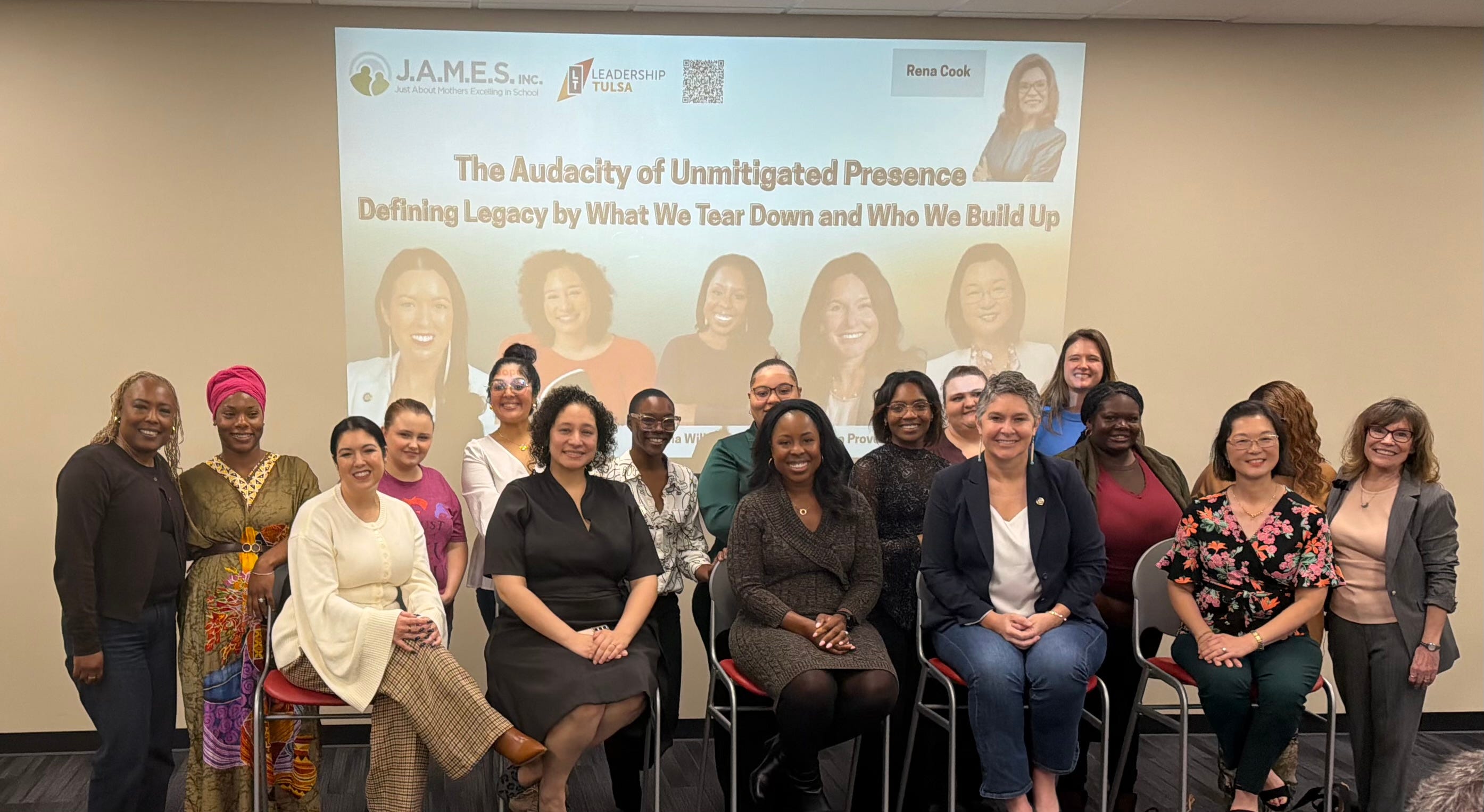
Provenzano told that story to answer a question about barriers existing for women in leadership. It was part of broader conversation on Sunday hosted by the nonprofit JAMES at Leadership Tulsa and moderated by Rena Cook, board member of Sally’s List.
The nonprofit (Just About Mothers Excelling in School) was founded by Alisa Davis-Bell to provide single mothers support and resources for continuing post-high school education. Its Young Parent Advisory Board asked a panel of smart, influential women about a range of topics.
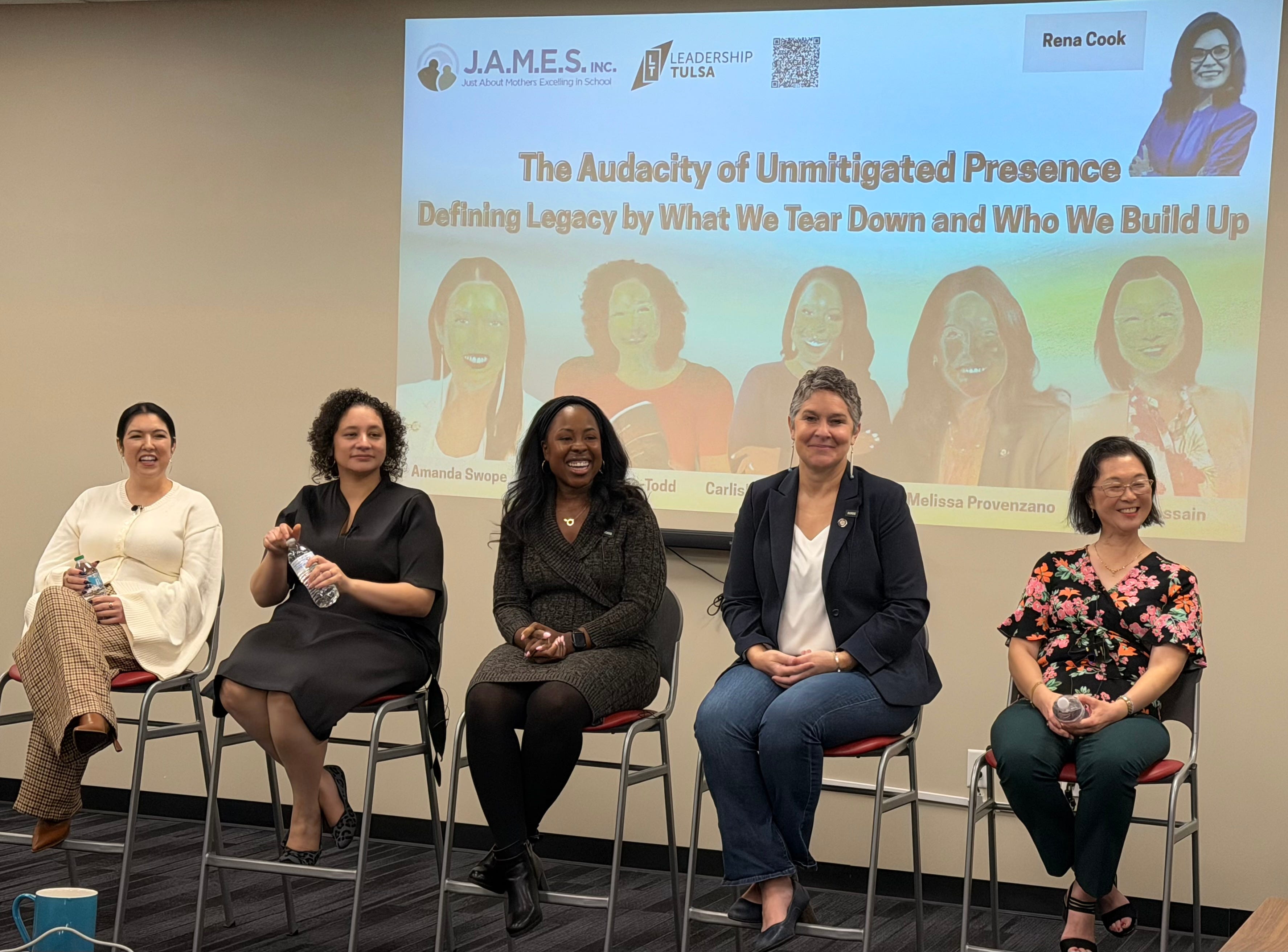
Leadership Tulsa Executive Director Marcia Bruno-Todd expanded on Provenzano’s example, pondering why men would push back on a women’s caucus.
“They’re scared of red and blue women together,” said Bruno-Todd. “What are they scared of? Perhaps - red or blue or Republican or Democratic - they are scared that if they collaborate, if they come together, they might create a new system or structure than how we’ve operated. That’s a valid fear because it will happen.”
Women often govern and lead differently because they face different obstacles and expectations. They have to find ways into patriarchal systems then maneuver through them.
Changing a system is difficult, even when women are in the majority leadership.
“How do we sit back and hold ourselves accountable?” asks Bruno-Todd. “Are we trying to perpetuate things out of tradition? Do these even serve us anymore? Do we want our children to live in a world where these roles are still existing?
“If not, then let’s make new ones together. Let’s show a different way. We have the power to do that collectively, not just as women but as collaborating across different cultural perspective as well.”
Finding your voice doesn’t have to be adversarial. It could be as simple as asking questions.
“You don’t have to shake the norms of debate. You can do that just by asking powerful questions at the right time in the right place,” said Bruno-Todd.
The frank discussion laid bare insecurities women have when being the minority voice in the room. Reassuringly, the panelists spoke about ways through the self-doubt.
Carlisha Williams Bradley, an award-winning speaker, executive coach and founder of two nonprofits to amplify women’s voices, spoke about her experience as the first Black woman appointed the Oklahoma State Board of Education in 2019. Her background as an educator and administrator supported charter schools. During her board tenure, the pandemic struck and the controversial State Superintendent Ryan Walters took office. It was the passage of House Bill 1775 that presented her biggest challenge.
HB 1775 was enacted in 2021 as an “anti-woke, anti-DEI” bill banning certain teachings about race and gender in K-12 schools. The vaguely written law states it’s illegal to teach anything to make a student feel “discomfort, guilt, or anguish” about their race or sex. Its effect has caused educators to avoid subjects and gave Walters a platform to target teachers.
“Being the only Black woman on the board, I had a lot of thoughts, feelings and reflections about my lived experience going to school here in Tulsa,” she said. “In the course of that time on the board, I had a lot of insecurities, even though I was the only person who had actually done policy, been an educator, been a superintendent to fill out the forms we reviewed at every single board meeting.
“I oftentimes would look around the table, and when there was no one who looked like me, I wondered, ‘Do I belong here? Should I speak up?’”
It became clear Bradley was going to be the lone “no” vote regarding policies around HB 1775.
“Instead of standing in my ‘no,’ I choose to tell my story,” she said. “I brought the story of my lived experience to the boardroom. I … started to speak my truth. That truly was the power of my voice.
“Your lived experience is power. Your lived experience prepared you for the tables and places you sit in. For me, that was a moment where I showed up fully.”
Bradley was asked if she feared being labeled an “angry Black woman” and, if so, how did she overcome those feelings. She turned the question around and asked how many Black women present worried about it. Every hand went up.
“We’re at 100%. Yes, it’s a very common stereotype,” she said.
Early in her executive leadership, Bradley was told by consultants to be friendlier and nicer. She was actually told to smile more. Those microaggressions led to self-reflection.
“Would you rather be respected or would you rather be liked? What I am sacrificing to be liked and to not be labeled?” she said. “The inner work that had to happen was really understanding what I value, what I stand for and what I believe in. It really began for me reframing what executive presence is.
“… At the end of the day, I’m rooted in knowing who I am, how I show up, why I’m here.”
Provenzano reinforced the notion to lean into personal experiences. She sponsored mammogram health insurance parity bills at the request of a constituent few sessions ago. Then, she was diagnosed with breast cancer last year and decided to talk about that experience. It resulted in an overwhelming number of Oklahomans reaching out to share their own stories.
“It was the storytelling and connecting with women, being willing to be vulnerable, and that made every woman respond back to me,” Provenzano said. “I learned a really powerful lesson: I’ve got to keep telling my story.”
Voting and civic engagement were emphasized, mentioning that it takes three to 10 times of asking a woman to run for office before she agrees. They spoke of resiliency, making pathways for women and finding strength in building coalitions.
Other panelists were former Rep. Amanda Swope, who now serves as the city of Tulsa’s director of Indian policy and partnerships, and Amy Hossain, the chief human resources officers at Domestic Violence Intervention Services and candidate for Oklahoma Senate district 34.
At the end, Cook summed up key takeaways from the panelists:
There is power in asking questions;
Lived stories are just as - if not more - important and more effective than facts and figures;
This is no space to be a victim;
Pitiful can never be powerful;
Form alliances;
Be the village;
Lean in with curiosity;
Connect across generations;
Ask yourself, “If not you, then who?”;
Don’t pass the buck;
Remember that we will not be forced to leave this space;
No one gets to identify who you are;
Be a servant leader;
Look inward to find strength;
What is more important than being liked?;
Character, confidence, communication and connect (Bradley’s four c’s); and
Every decision is trade-off, there is no real win-win situation.